Saturday, February 18, 2017

Gwynne Shotwell pre-launch briefing at LC-39a

During a pre-launch briefing held by NASA, SpaceX's President Gwynne Shotwell discussed a lot of assets of the new pad and how honoured SpaceX is about leasing the historic pad. She stated that SpaceX has taken good care of the pad and saved 'precious' parts of the launch pad and upgraded things for their use. The rotating service structure is also being taken down piece-by-piece whenever they have time for it and giving the scrap metal back to NASA. After that, they moved to the Q&A part of the briefing where people asked many different questions on upcoming launches, Mars, reusability, and crewed missions. Gwynne stated that Falcon Heavy will be flying this summer once LC-40 is back up and running, as well as there are many customers wanting to fly on FH. She also talked about Red Dragon and that they're now looking more toward the 2020 timeframe for the first launch. SpaceX wants to put more time and resources into the program before launching so they can also
focus on Crew Dragon and Falcon Heavy. SpaceX is planning on starting crewed launches in 2018 and Gwynne is confident that will happen on time. Along with crew launches, they've been working on a redesign on the Merlin engines because of cracks in the turbine wheel that they've been flying with for all Falcon 9 launches. The redesign needs to happen so the engines have no issues during launch for the safety of the crew and they will be used sometime this year. Nothing was revealed about the spacesuits for the crew but Gwynne said that they look "really cool". Reusability was then brought into conversation and that the second stage will not be reused for any of the Falcon rockets because of high orbital speeds. Although, she addressed that fairings will be recovered and reused on one of the following missions this year. The first reused booster will be launched on the SES-10 mission from LC-39a sometime in March. Launch Complex 40 should be up and running sometime this summer. She also said that the Falcon 9 Block 5 has an increase in
performance, some manufacturing improvements, and about 100 other changes on the vehicle. With all this information given to us, it shows that this year will be a big year for SpaceX with the maiden launch of Falcon Heavy, the first reused booster, and recovery of the payload fairings.

Thursday, February 16, 2017

SpaceX Falcon 9 and Dragon vertical at LC-39a (Photos)

Official SpaceX CRS-10 Mission Patch

Falcon 9 and Dragon vertical at LC-39a
(Flickr: SpaceX)


Falcon 9 and Dragon vertical at LC-39a
(Flickr: SpaceX)

Wednesday, February 15, 2017

PSLV liftoff with Cartosat-2D and 103 other satellites

India's Polar Satellite Launch Vehicle (PSLV) will be lifting off from the First Launch Pad at the Satish Dhawan Space Center in Sriharikota, India. The Cartosat-2D satellite is a part of a series of satellites and will be the fifth one launched. These satellites are Earth observation satellites that sit in a sun-synchronous orbit, meaning they orbit the Earth with the sun always in view. The PSLV launched from India at 10:58 pm EST on February 14th marking the 39th launch of the rocket. Along with carrying the Cartosat-2D satellite, it also brought up 103 small satellites exceeding the record of a number of satellites brought into orbit successfully. 

Tuesday, February 14, 2017

Ariane 5's first launch of the year

The Ariane 5 launched 2 key satellites, Sky Brasil 1 and Telcom 3S at 4:39pm EST from French Guiana. Sky Brasil 1 is going to support subscription television services by DirecTV, a subsidiary of AT&T.  Weighing in at over 13,000lbs, the satellite has 60 Ku-band transponders onboard and will be positioned along the equator at 43.1 degrees west longitude. Sky Brasil 1 will replace the Intelsat 9 satellite which has been in orbit since July 2000. The Telkom 3S satellite is being launched to help support high-definition television broadcasts, communications, and internet services. The satellites carried 32 C-band and 10 Ku-band transponders and is owned by Telkom Indonesia. It weighs in at about 7,800lbs and was built by Thales Alenia Space and will reach customers across Indonesia, Malaysia, and other parts of Southeast Asia. Telkom will be replacing Telkom 2 which was launched n November 2005.

Sunday, February 12, 2017

Flames return to LC-39a

Photo of static fire at LC-39a
(Photo: Matthew Travis/Zero-G News)
After almost 5 1/2 years fire has returned to the historic Launch Complex 39a. SpaceX completed the hold-down firing of the rockets 9 Merlin 1D engines for approximately 3.5 seconds. The static fire was done 6 days prior to the launch of their Dragon spacecraft to the ISS for the CRS-10 mission. The rocket produced nearly 2 million pounds of thrust during the firing at full power. This static fire was set as a milestone for SpaceX as it double-checked the readiness of the Falcon 9 to launch this Saturday.  

Friday, February 10, 2017

Falcon 9 vertical at Launch Complex 39A

For the first time since the last launch of the Space Shuttle in 2011, a rocket stands tall on the historic launch pad. Today, SpaceX erected their Falcon 9 rocket with no payload on top for the first time at LC-39A to test systems for the upcoming CRS-10 launch on February 18th. Static fire is set for tomorrow with a confirmation from @NASASpaceflight on twitter, "KSC workforce provided with a notification there won't be a SpaceX Static Fire today. Saturday's window opens at 1700, ends 0500 Eastern.". People are awaiting as SpaceX gears up for the first launch off this historical launch pad next week bringing back launches from LC-39A since the launch of STS-135.

Thursday, February 9, 2017

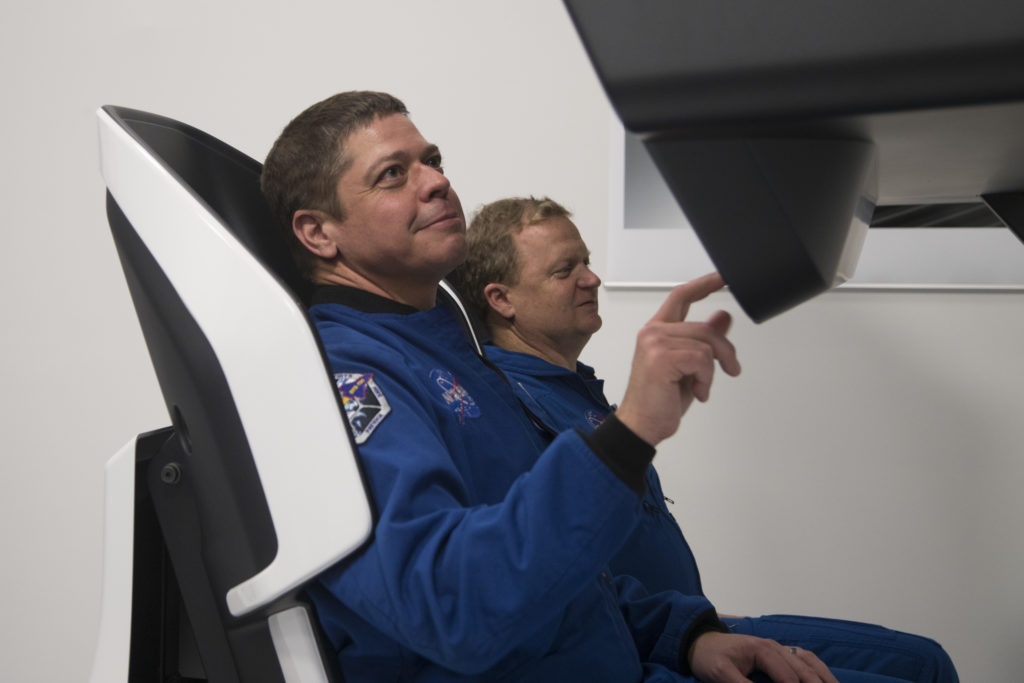
Commercial crew astronauts check Crew Dragon controls

Astro_Visit_1.10.17-7
Bob Behnken (Left) and Eric Boe (Right) Evaluating the controls
Credit: SpaceX
Astronauts that will be flying to the ISS in Boeing's CST-100 Starliner and SpaceX's Crew Dragon spacecraft visited SpaceX's headquarters in Hawthorne, CA to evaluate the controls of the spacecraft. Bob Behnken and Eric Boe checked out the controls, seating and the crew compartment of SpaceX’s Crew Dragon spacecraft. They sat in a mockup of the cockpit and looked at the aspects of the layout of the displays and the ease of movement in the seats while using the control panel. SpaceX has designed their spacecraft to allow the crew to be comfortable for their ride to the ISS and build models like these to be tested to help determine the practicability of all the systems. Bob and Eric, along with Doug Hurley and Suni Williams have been traveling the country to evaluate the designs of both SpaceX's and Boeing's spacecrafts as the two companies work toward their first launches next year.

Wednesday, February 8, 2017

SpaceX's first launch from LC-39A


SpaceX renovating LC-39A, April 8th, 2016
Spaceflight News
SpaceX has been working hard on getting their new launch pad ready. Launch Complex 39A, which used to launch Space Shuttles and Apollo Saturn V rockets, was leased to SpaceX in April of 2014 to support the launches of their Falcon Heavy rocket. With the pad anomaly back in September resulting in the loss of the vehicle and payload along with major damage to the launch pad, SpaceX will now be launching their Falcon 9 rocket to catch up on their backlog. They have officially announced on Twitter that the first launch from LC-39A will be CRS-10 with the Dragon spacecraft to carry supplies to the ISS and will launch on February 18th at 10:01am EST. It is said to be a "Return to launch site" (RTLS) 1st stage landing and will be the first daytime landing
CRS-8 standing at Launch Complex 40
Spaceflight News
back on land. Nearly 
2,029 kg (4,473 lb) of pressurized cargo will be loaded into the ISS and 977 kg (2,154 lb) of unpressurized cargo will be stored in Dragon's trunk. One of the primary payloads that will be carried up and mounted to the ISS is the Stratospheric Aerosol and Gas Experiment, also known as SAGE III. After being mounted onto the Space Station, it will make long-term measurements of ozone, aerosols, water vapor, and other gasses in Earth's atmosphere.

Wednesday, January 18, 2017

SBIRS GEO-3 satellite to launch aboard Atlas V rocket

Atlas V NROL-36 standing on Launch Pad at VAFB
 (Credit: United Launch Alliance)
United Launch Alliance's Atlas V rocket will be launching the SBIRS GEO-3 satellite. Built by Lockheed Martin and being launched for the U.S Military to detect missile launches and provide tactical support. The launch is set for January 19th from Launch Complex 41 in Cape Canaveral, Florida with a launch window that opens at 7:46 pm EST. SBIRS is The Space Based Infrared Systems Geosynchronous Earth Orbit and will be the third of this satellite to be launched in 2011 and will replace the old DSP (Defence Support Program) constellation that has been in operation since 1970. The satellite will help in early missile detection using infrared equipment. The rocket will fly in its 401 configuration with a 4m wide fairing and 1 Centaur second stage engine with no SRBs (Solid Rocket Boosters).

Saturday, January 14, 2017

Successful launch of 10 Iridium satellites by SpaceX

SpaceX has successfully launched and deployed 10 Iridium satellites for communications. As well as successfully launching the Falcon 9 back to flight, they landed the first stage back on the droneship JRTI (Just Read The Instructions) for the first time from the West Coast. During the livestream after first stage separation, the video feed from the first stage continued all the way down to the landing on the droneship without losing connection for the first time. Becoming the first US Launch of the new year, SpaceX launches with a successful launch and return to flight.

Friday, January 13, 2017

SpaceX to launch 10 Iridium satellites


Falcon 9 vertical at VAFB, California
Photo: SpaceX
Tomorrow (Saturday, January 14th) at 12:54 pm EST/5:54 pm UTC SpaceX will return to flight with the launch of 10 satellites for IridiumNEXT atop a Falcon 9. This will be the first launch by SpaceX after their launch pad anomaly during fueling of AMOS-6 which was caused by a fault in the second stage helium tank. The Falcon 9 will be launching from VAFB (Vandenburg Airforce Base), California at Space Launch Complex 4E. The first stage will then separate approximately 2 minutes and 27 seconds after liftoff and will be attempting to launch back on the droneship "Just Read The Instructions". If the first stage lands successfully, it will be the first time they've landed on JRTI. These 10 satellites are the first of at
Official Iridium-1 patch
Photo: SpaceX
least 70 in the constellation that SpaceX will be launching for Iridium. They will replace the world's largest commercial satellite network of low-earth orbit satellites which will become one of the largest tech upgrades in history. The satellites will be deployed 10 at a time by SpaceX and all of at least 70 will be in orbit by 2018. 

New droneship under construction for SpaceX rocket recovery

"Of Course I Still Love You" positioned in the Atlantic Photo // SpaceX To this date, SpaceX currently has 2 droneships to lan...